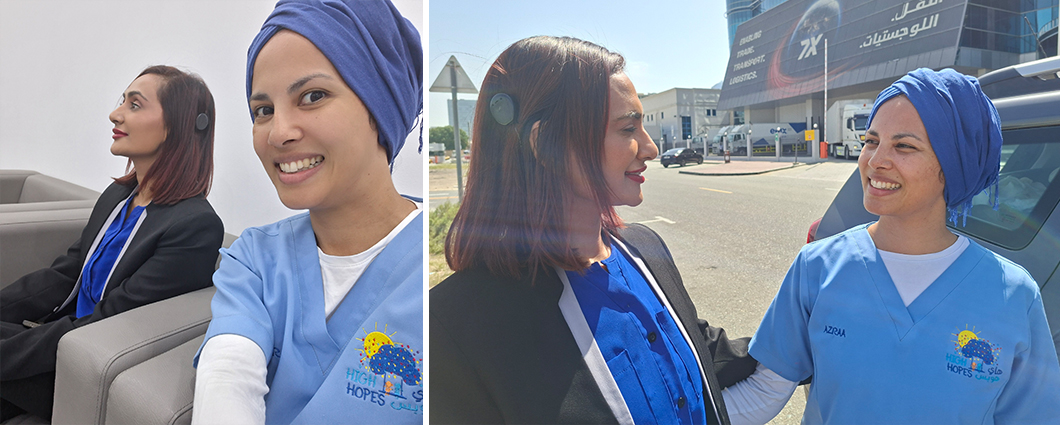
Recently, I had the opportunity to interview my dear friend Kathija, a successful businesswoman with a cochlear implant, and hear her reflect on her journey with hearing loss, speech and language therapy, and family support. Better Hearing and Speech Month felt like the perfect time to share this.
What stood out immediately was her honesty and humour. Speaking about her early childhood, she laughed as she recalled saying to her mother:
“See, I wasn’t naughty; I couldn’t hear you!” in response to her mother sharing that she had truly thought that “Kathija was just a really naughty child!”
It was a light-hearted conversation, but it captured something important. During a crucial part of her early years, Kathija lived with undiagnosed severe hearing loss, at a time when the foundations for speech, language and learning are being established. Although she had been screened at birth, her hearing loss was acquired afterwards, reminding us that even children who pass newborn screening can develop hearing differences. During this period, what may have looked like inattention or non-compliance to her family was, in fact, reduced access to sound.
Early experiences and their impact
One of the strongest themes from our conversation was how much these early years matter. Kathija described the period before her diagnosis at age two; how often she was reported to have missed instructions and appeared unresponsive.
It made me reflect on how many children may be navigating similar experiences, doing their best in environments that don’t yet meet their needs. Once her hearing loss was identified, things began to shift. She was fitted with hearing aids and began speech and language therapy. Between the ages of two and six, she received consistent support both in sessions and at home.
She described this time as foundational, not just for developing listening and speech, but for building confidence in communication.
Building on early foundations
Another thing that stood out was how her journey didn’t begin at a single moment, it built over time. By the age of six, Kathija received her cochlear implant, proudly recalling how she travelled across South Africa to the nearest hospital offering the procedure at the time. She emphasised that she already had years of listening experience and early language skills behind her.
The implant enhanced her access to sound, building on the foundation that had already been carefully developed: hearing as the basis for listening. Early support, even when progress felt gradual, did vital work in the background, preparing her to make the most of her cochlear implant.
The power of family commitment
It was impossible to listen to Kathija’s story without noticing how frequently she highlighted her mother’s role. She spoke about the two-hour bus journey to therapy each week-not as a dramatic detail, but simply as part of their routine.
What stood out wasn’t just the effort, but the consistency. Her mother followed recommendations at home, and as Kathija fondly mentioned, “she made my whole family practise too.”
Reflecting on this, it’s clear that families often do far more than they realise. That consistency builds more than skills, it builds confidence, which I saw clearly in Kathija.
Expanding communication
One of the most meaningful parts of our conversation was how confidently Kathija spoke about sign language. She didn’t frame it as an alternative or a last resort; she described it as a strength.
Being fluent in spoken English and South African Sign Language gave her flexibility and confidence in ways hearing alone could not. This reminds us that communication is not limited to one mode but when we expand how a child can express themselves, we reduce pressure, increase confidence, and support a total communication approach.
Families learning sign language
Kathija spoke about how meaningful it is when families learn to sign alongside their children. She described siblings practising, parents trying (even getting it slightly wrong), which children often love correcting.
It’s not about fluency straight away; it’s about willingness. Especially here in the UAE, during the Year of the Family, this feels particularly important. Communication doesn’t have to rest on one person adapting alone. When families join in, connection becomes more natural and far more inclusive.
Understanding progress and challenges
Kathija was also open about the challenges she faced, particularly with high-frequency sounds like /s/ and /sh/. These took years to develop clearly.
Listening to her reinforced something important: progress doesn’t always look quick or obvious. It can be gradual, inconsistent, and sometimes frustrating, but with the right support, those small steps build into meaningful achievement.
The importance of knowing hearing levels
Throughout our conversation, it became clear how essential it was that her therapy was guided by her hearing levels, experiences, and needs at each stage. When we understand what a child can actually hear, we can support learning without overwhelming them.
Her story also reminded me why we learn this critical point as clinicians: early hearing checks matter and so does ongoing monitoring. Hearing differences don’t always look obvious.
Without checking hearing, it’s easy to misinterpret these signs as behavioural or developmental concerns.
Knowing a child’s hearing levels allows us to:
- Align therapy to what a child can access
- Set measurable and appropriate goals
- Adjust communication strategies
- Reduce frustration for the child and family
- Monitor progress
When should parents check hearing?
Hearing should always be considered when there are concerns about speech, language, or listening.
Even when children pass newborn hearing screening, hearing loss can still develop later due to illness, fluid, recurrent ear infections, genetics, or other acquired causes. This is why hearing checks remain such an important part of understanding a child’s communication development.
Parents may want to consider a hearing assessment if they notice that a child:
- Is not responding consistently to their name
- Has delayed speech or unclear words
- Displays difficulty following instructions
- Frequently says “what?” when spoken to
- Seems inattentive or “selective” in listening
- Needs the TV louder than usual
- Becomes frustrated during communication
Checking hearing is never a wasted step. If a hearing difficulty is identified, it provides the information needed to support listening, speech, and language more effectively.
And if hearing is normal, that is still incredibly valuable. It helps rule out one possible cause and allows us to focus on other areas of communication development, with the right therapy goals and support in place.
Belonging and inclusion
Kathija spoke with genuine appreciation about living in the UAE as a Person of Determination. She highlighted the access to services and the respect she experiences.
This added another layer to her story not just about overcoming challenges, but about being supported by an environment that values inclusion and accessibility.
Supporting inclusion and access is at the heart of High Hopes do reach out to us if you have concerns.