Did you know it is Spinal Muscular Atrophy (SMA) Awareness Month?
Every August, SMA organisations run initiatives to raise awareness for the condition. In this blog, we will review important updates from the SMA community around the world and particularly highlight best occupational therapy practices for SMA.
What is SMA?
Spinal muscular atrophy (SMA) is a progressive neurodegenerative condition that affects the motor nerve cells in the spinal cord and causes muscle weakness. Cure SMA, a leading organisation for driving SMA research, explains that no two people with SMA have identical experiences and therefore, decisions about care and treatment should be made according to each individual’s needs.
Medical Breakthroughs
In the last 10 years, there have been incredible breakthroughs for SMA treatment, with significant advancements made in this past year!
Gene therapy was first approved in 2019 for children under the age of two. It is a one-time-only treatment that halts the progression of the condition by replacing the missing gene. In November 2025, the U.S. Food and Drug Administration (FDA) approved a new gene therapy for children over two years of age and adults with SMA, expanding treatment access across the lifespan and offering more individuals the opportunity to improve motor function and reduce muscle weakness.
Dubai healthcare is right at the forefront of these new advances. Dr Vivek Mundada and his team at Medcare Royal Specialty Hospital in Dubai successfully administered the newly licensed gene therapy to an adult patient with SMA, becoming the first location outside the United States to do so (Gulf News, April 2026).
As recently as March 2026, there have been updates to an already established therapy (SPINRAZA®), with the FDA approving higher doses, which studies indicate can improve motor milestones and slow the rate of degeneration.
Early Identification and Advocacy
With these new medical treatments, early identification has become more important than ever. SMA Europe campaigned heavily to achieve newborn screening for all babies born in Europe by 2025. Approximately twenty countries met this goal for 2025, with more countries doing so this year. Both Scotland and Ireland,introduced the screening to their national healthcare systems in early 2026.
Parents have been sharing their stories to help highlight the importance of the newborn screening for early treatment. A well-known UK singer, Jesy Nelson, whose twin daughters, born in 2025, were diagnosed with SMA, launched a national petition and publicly campaigned for the inclusion of SMA in the NHS (National Health Service) newborn blood spot screening programme. Following significant public and professional advocacy, the UK Government announced in July 2026 that every baby born in England will receive newborn screening for SMA, with testing beginning from October 2026. According to BBC News, Nelson reacted to the government’s announcement:
“Today is a day of hope. Knowing that future families will have access to early diagnosis and the opportunity for the best possible outcomes is something I’m incredibly proud to have supported.”
So far, 2026 has seen many positive changes for early identification and advanced treatment options for SMA. Although medical interventions have transformed the prognosis of SMA, international standards of care continue to emphasise that comprehensive multidisciplinary management, including occupational and physical therapy, remains essential to optimising function, participation and quality of life.
Best Occupational Therapy Practices for Spinal Muscular Atrophy (SMA)
In recent years, there has been a shift in focus from primarily preventing decline to maximising functional independence and participation. For this blog, we will focus on five evidence-based, best-practice strategies in occupational therapy for children with SMA.
- Goal-Directed and Occupation-Based Therapy
A cornerstone for occupational therapy intervention is ensuring the goals of therapy are centred on meaningful activities for the child’s everyday life. Using the Canadian Model of Occupational Performance and Engagement (CMOP-E) the occupational therapist is led to consider the following areas for intervention:- Self-care: feeding, dressing, bathing, toileting, etc.
- Productivity: nursery and school participation, learning activities, handwriting, completing simple household tasks, etc.
- Leisure/Play: playing with peers, playing with toys, arts and crafts, community activities, swimming, hobbies, etc.
Once the specific everyday activities have been identified as being meaningful areas that require intervention, the OT is then led to consider if intervention should focus on the Person, the Environment or the Occupation (PEO model) or a combination:
- Person: Build the child’s skills so they can complete the activity. For example, strengthen hand strength and coordination to be able to use a knife and fork so the child can feed themselves independently.
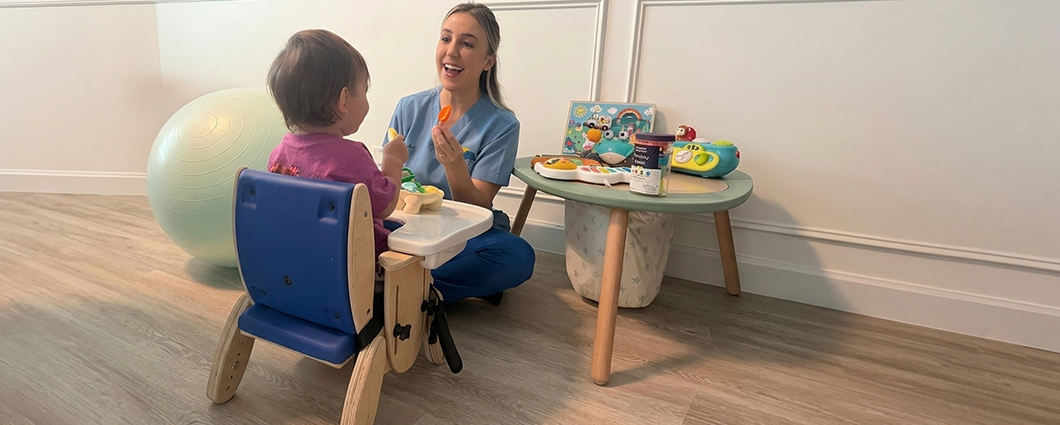
- Environment: Change the environment or add supportive equipment. For example, provide supportive seating so the child has adequate postural support to be able to complete table-top activities.
- Occupation: Change aspects of the occupation/activity. For example, use typing instead of handwriting to produce schoolwork.
The occupational therapist needs to consider that children with SMA are now achieving new motor milestones following treatment, so therapy should support functional skill acquisition rather than simply maintaining existing abilities.
- Maximise Upper Limb Function
The key shift in SMA management over the last decade is that upper limb function has become one of the primary indicators of independence and participation. It has also been proven in studies that upper limb function can show measurable improvements following disease-modifying treatment, even when improvements in gross motor ability are smaller, further emphasising the importance of focusing on upper limb function for intervention. An important consideration for occupational therapists is that upper limb function should be measured and treated in terms of meaningful activities such as playing (e.g. Lego), eating and drinking (e.g. opening a bottle or lunchbox container), dressing (e.g. buttons or zips), and not simply muscle strength. - Assistive Technology and Environmental Adaptation
In a 2025 review of all rehabilitation strategies for SMA, posture management and assistive device application were identified as one of the four major pillars of SMA rehabilitation. Assistive technology is evolving beyond traditional equipment. Smart home technology can allow children with severe physical limitations to independently control their environment, supporting autonomy and participation. - Manage Fatigue Through Energy Conservation
Energy conservation is not about encouraging children to do less; it is about enabling them to do more of what matters. Advice from recent research articles emphasises balancing activity with adequate rest, adapting tasks, modifying environments and prioritising meaningful occupations to optimise endurance throughout the day. - Adopt a Family-Centred, Multidisciplinary Approach
Current evidence supports a family-centred, multidisciplinary approach as essential for occupational therapy in SMA. Song and Ke (2025) recommend coordinated, individualised care involving families and healthcare professionals to maximise functional abilities, participation and quality of life throughout childhood
Reflecting on Progress
As we mark SMA Awareness Month this August at High Hopes, it is an opportunity to celebrate how far the SMA community has come. Advances in newborn screening, disease-modifying therapies and evidence-based occupational therapy are transforming outcomes, enabling children with SMA to lead healthier, more independent and fulfilling lives than ever before.
References:
- Ahmed, A. (2026, April 29). Dubai achieves global first with breakthrough gene therapy for adult SMA patient. Gulf News.
- Bieniaszewska, A., Sobieska, M., Steinborn, B., & Gajewska, E. (2023). Examination of upper limb function and the relationship with gross motor functional and structural parameters in patients with spinal muscular atrophy. Biomedicines, 11(4), 1005. https://doi.org/10.3390/biomedicines11041005
- Biogen Inc. (2026, March 30). FDA approves new high dose regimen of SPINRAZA® (nusinersen) for spinal muscular atrophy. https://investors.biogen.com/news-releases/news-release-details/fda-approves-new-high-dose-regimen-spinrazar-nusinersen-spinal
- Cure SMA. (n.d.). About Cure SMA. https://www.curesma.org/about-cure-sma/
- Department of Health and Social Care, NHS England, National Institute for Health and Care Excellence, & Murray, J. (2026, July 16). Every baby in England to get life-saving genetic test from birth. GOV.UK. https://www.gov.uk/government/news/every-baby-in-england-to-get-life-saving-genetic-test-from-birth
- Finkel, R. S., Crawford, T. O., Mercuri, E., Sumner, C. J., Garcia Romero, M. del M., Day, J. W., Montes, J., Sun, P., Tichler, B., Paradis, A. D., Boesch, E., Inra, J., Littauer, R., Sohn, J., Monine, M., Gambino, G., Foster, R., Farewell, R., Fradette, S., et al. (2026). High-dose nusinersen for spinal muscular atrophy: A phase 3 randomized trial. Nature Medicine, 32(3), 1095–1104. https://doi.org/10.1038/s41591-025-04193-6
- Health Service Executive. (2026). Management of infants with a suspected diagnosis of spinal muscular atrophy (SMA) through the National Newborn Bloodspot Screening Programme (NNBSP). https://www2.healthservice.hse.ie/organisation/national-pppgs/management-of-infants-with-a-suspected-diagnosis-of-spinal-muscular-atrophy-sma-through-the-national-newborn-bloodspot-screening-programme-nnbsp/
- Kirby, J. (2026, July 16). Jesy Nelson calls plan to test newborns for life-limiting muscle condition a “victory”. BBC News. https://www.bbc.com/news/articles/cly2w1qxxxxx
- Kirschner J, et al. (2024). 2024 update: European consensus statement on gene therapy for spinal muscular atrophy. European Journal of Paediatric Neurology.
- Law, M., Cooper, B., Strong, S., Stewart, D., Rigby, P., & Letts, L. (1996). The Person–Environment–Occupation Model: A transactive approach to occupational performance. Canadian Journal of Occupational Therapy, 63(1), 9–23. https://doi.org/10.1177/000841749606300103
- Mercuri E, et al. (2018). Diagnosis and management of spinal muscular atrophy: Part 1: Recommendations for diagnosis, rehabilitation, orthopedic and nutritional care. Neuromuscular Disorders, 28(2), 103–115.
- Mirasol, F. (2026, February 5). High-dose nusinersen slows neurodegeneration in SMA patients, study shows. BioPharm International. https://www.biopharminternational.com/view/
- NHS. (n.d.). Spinal muscular atrophy (SMA). NHS. https://www.nhs.uk/conditions/spinal-muscular-atrophy-sma/
- Polatajko, H. J., Townsend, E. A., & Craik, J. (Eds.). (2007). Enabling occupation II: Advancing an occupational therapy vision for health, well-being & justice through occupation. Canadian Association of Occupational Therapists.
- Ruggiero, M., Giannotta, G., Morleo, G., Oliva, M. C., Ferrante, C., & Trabacca, A. (2026). Limitations in activities of daily living in individuals with spinal muscular atrophy: A scoping review and multidisciplinary recommendations for clinical practice. Journal of Neuromuscular Diseases, 13(4), 602–612. https://doi.org/10.1177/22143602251397438
- SMA Europe. (n.d.). SMA Europe. https://www.sma-europe.eu
- Song, W., & Ke, X. (2025). Rehabilitation management for patients with spinal muscular atrophy: A review. Orphanet Journal of Rare Diseases, 20(1), 352. https://doi.org/10.1186/s13023-025-03888-w
high-dose-nusinersen-slows-neurodegeneration-in-sma-patients-study-shows