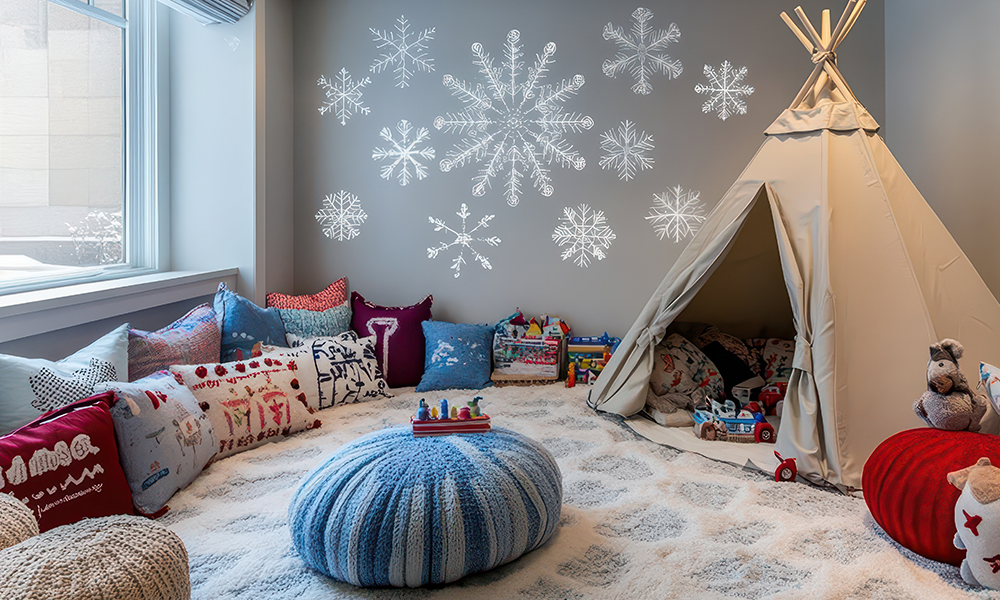

Winter holidays can mean slower mornings, cozier routines, and long afternoons at home. These are times that lend themselves to connection and shared activities. For children experiencing communication delays or language learning challenges, these stretches of unstructured time can be shifted into opportunities for growth. One of the most effective ways to do this is through thematic language play, where families use a single unifying theme, in this case, winter, to organize play, routines, books, and conversations. For a family winter theme focus, you could choose snow, animals, holidays, or winter sports, to name a few.
Thematic approaches to language and literacy have been supported in the research for decades in early childhood education, special education, and speech and language intervention. They move away from isolated, uninspired drills and worksheets and toward engaging, meaningful, and context-rich learning experiences.
Why Thematic And Play-Based Language Support Works!
- Embedding language in meaningful contexts:
Thematic instruction (also called theme-based learning) organizes content around a central, relevant theme rather than disconnected skills or drills. This approach encourages children to make connections between new vocabulary, actions, and real-life contexts.
In the context of winter, words like “snow,” “cold,” “coat,” “hot chocolate,” “ice,” “coat,” “gloves,” “in,” “out,” “under,” “on,” “off,” and more become meaningful because they tie into actual experiences: dressing for the cold, pretending to make hot drinks, playing with snow-like materials. - Motivation, engagement, and inclusion:
Thematic learning invites variety: games, crafts, reading, and pretend play, which caters to different learning styles, intelligences, and preferences. This flexibility helps children stay motivated.
For children who use Augmentative Alternative Communication (AAC), the repetition of meaningful contexts lowers cognitive load and gives multiple chances to hear and use target words or structures. Reviews of language-focused interventions have found that children make the most progress with naturalistic, routines-based, play-infused approaches, especially when the interventions are culturally and linguistically responsive. - Rich opportunities for language growth:
Quality early language intervention requires responsive, adult conversational input. Expansions, recasts, open-ended questions, and scaffolding during daily interactions boost language stimulation. Thematic and guided play merge child-led exploration and adult input, a combination proven to be very effective.
Also, by anchoring learning to topics relevant to children’s lives (e.g., winter clothes, snow), you aid children in building vocabulary, sequencing (first, next, last), reasoning and problem solving, and contextual grammar use, all of which are foundational for later storytelling, social, and academic readiness.
Finally, and perhaps most importantly, thematic learning views language as a tool for real communication, rather than just an isolated skill to be mastered. This approach to language learning tends to keep children engaged, ultimately leading to more generalization of the skill.
Six Winter-Themed Language Activities
Using these guiding principles, here are six winter-themed language activities aimed at increasing engagement, communication, and learning for children with diverse communication needs.
- Dressing for Winter: Routine Play with Language
Use dressing, a daily routine, as a language-learning opportunity. Gather winter items (coat, hat, scarf, gloves, boots, socks). Let the child choose items or help you sort them (e.g., “things for your head,” “things for your hands”).
Narrate each step slowly and meaningfully: “I’m putting on your hat,” “zip coat,” “coat on,” “coat off.” Use repetition, gesture, and, if relevant, AAC, including printed boards or a device.
Ask simple questions or give choices: “Hat or scarf?” “Gloves or mittens?” “Do you want help?” Later, reverse roles: let the child “dress you” or dress a doll.
What this builds on includes, vocabulary (“hat,” “coat,” “gloves,” “cold,” “zip,” “on/off”), requests, choices, sequencing (first coat, then hat, then gloves), functional language for daily life. The repetition across contexts (morning, going out, coming back) helps generalization. - Winter Sensory Bin or Tray
Sensory play is motivating, tactile, and perfect for contextualizing winter vocabulary and concepts.
Materials to use can include cotton balls (as snow), ice cubes or frozen water, rice or salt for “snow,” small toy animals (penguins, polar bears, etc.), cups, spoons, and tongs.
Invite your child to explore (“touch the snow,” “feel the cold,” “ice is cold”).
Describe actions: “Put the ice in the cup,” “Take it out,” “Make a big snowball,” “I have a small snowball.”
Use pretend play, “Our penguin is stuck under the snow! Let’s rescue it.” Use tongs or spoons to free it, and narrate every step: “We grab, we pull, it’s free!”
Encourage your child to describe what they feel/see, or give simple choices (“Do you want the penguin or the polar bear?”). What this builds on includes prepositions and spatial concepts (“in,” “out,” “under,” “on”), adjectives (“cold,” “big,” “small”), verbs (“grab,” “pull,” “rescue”), problem-solving language, and expressive language through pretend play. - Snowman Craft with Language Sequencing
Crafts invite fine motor work, creativity, and structured language use through sequencing and description.
Materials to use can include paper circles/cotton pads/playdough for the snowman body, markers/buttons for face/eyes, scarf/hat/arms, glue or tape.
Provide simple sequences by giving step-by-step instructions like, “First, we make a big circle (snowman base). Next, a smaller circle (middle). Then, a small circle (head). Last, we add eyes, nose, and scarf.” Use sequencing words (first, next, then, last), and encourage your child to narrate or choose what comes next. You may use visuals and pictures on an AAC to support and facilitate, where needed.
Once done, talk about the snowman: “What’s his name?” “Is he big or small?” “Does he feel cold or warm?” “What is he holding?”
What this builds on includes, sequencing language, vocabulary (body parts, clothing), descriptive language (big, small, cold, warm), simple grammar, and narrative skills (naming, describing, role-play). - Winter Stories, Songs, and Shared Reading
Use winter-themed stories or songs to build vocabulary, comprehension, joint attention, and narrative skills.
Select any winter-themed story or song (even a simple winter poem or rhyme). Read or sing together. Keep it slow and interactive.
Pause to comment or ask questions: “What is that child wearing?” “What is he doing?” “Do you think he is cold/happy/sad?” Encourage pointing, gesturing, or AAC responses through modelling. After reading, invite your child to retell the story or draw a simple three-frame comic (beginning, middle, end).
You can also extend the story: “What happens after the snow stops?” or “What do you want to build with snow?”
What this builds on, includes listening comprehension, vocabulary, wh-questions, narrative structure (beginning-middle-end), expressive language, perspective-taking and imagination. - Pretend Hot Chocolate Café / Winter Kitchen
Pretend play is well documented as a powerful context for natural language, especially social interactions, requests, turn-taking, and imaginative dialogue. Guided play + adult scaffolding yields strong results.
Use real or toy cups, spoons, and small bowls. Pretend ingredients, cotton-ball “marshmallows,” paper “sprinkles,” warm water, juice, or actual hot chocolate.
What vocabulary you can model includes “Pour water,” “stir,” “hot,” “warm,” “want,” “more,” “please,” “thank you,” “my turn,” and “your turn.” Encourage role play and specific terms like: “customer,” “barista,” “friend,” family member.
You can also extend play by introducing simple problems like, “We ran out of marshmallows. What should we do?” Invite your child to suggest solutions, name ingredients, serve drinks, ask for help, etc.
What this builds on includes social routines, requesting, turn-taking, imagination, sentence expansion, and functional communication, all within a meaningful, play-based context. - Winter Treasure Hunt / Spatial Language Hunt
A treasure hunt is motivating, active, and a great way to practise spatial prepositions, descriptive words, and directives.
How to set the game up: Hide small objects (winter-themed toys, paper snowballs, stickers, or winter trinkets) around a room or house. Use simple clues to guide your child: “Look under the table,” “Check next to the chair,” “Is there something on the shelf?”
For AAC users, you can pre-program clue-words onto devices or make communication boards with the words (on, under, next to, behind, look, find) so they can give clues back to you.
This builds on spatial prepositions, directive vocabulary, listening/comprehension skills, vocabulary for objects, and following or giving instructions.
General Tips for Integrating Ideas:
- Follow and be attentive and responsive to the child. They should be able to determine what to do next and where to go. Take what they are paying attention to and use that as a starting point to model and expand the language around it. Being responsive to them is what effective language support is all about.
- Use repetition across different contexts of play routines and activities. Using the same words/concepts to do different activities like dress-up, book time, and treasure hunts is helpful for retention and generalization.
- Combine different activities together. Flexible activities like guided play, one-on-one or small group, and daily routines are great for providing opportunities to use meaningful language.
- Thematic play is great to support diverse learners. It can be adjusted for toddlers, preschoolers, or children with AAC, different learning styles, etc. As the literature on thematic instruction with culturally and linguistically diverse learners shows, the greatest impacts come from responsive, culturally and flexibly designed support across all environments.
- Instead of drills, natural connection and interaction should be the focus. The aim should be functional communication, not mechanical repetition. Encourage natural curiosity and interaction, contextual repetition, and problem solving.
Useful Websites to Use:
For speech and language ideas:
- The Hanen Centre
https://www.hanen.org
Great for early language strategies and parent friendly tips, especially for neurodiverse children - Speech and Language Kids
https://www.speechandlanguagekids.com
Activities, explanations and home-based strategies.
For AAC support:
- AssistiveWare Parent Resources
https://www.assistiveware.com/learn-aac
Clear guides for modelling and supporting AAC at home.
For general early years activities:
- Zero to Three
https://www.zerotothree.org
Great for toddler development and play based learning ideas.
Summary:
The holiday season provides the ideal, stress-free environment for language development through play, connection, and shared experiences because of its comfortable routines, creative potential, and opportunities for theme-rich vocabulary. Thematic play encourages children to use language naturally, to request, describe, imagine, sequence, solve problems, and interact, instead of concentrating on worksheets or drills.
The activities stated in this blog are more than just enjoyable; they are evidence-based strategies that promote vocabulary development, grammar, social communication, narrative skills, and confidence, whether your child uses speech, gestures, signs, or AAC. They are based on decades of research on thematic instruction, responsive language input, small-group interventions, and inclusive education.
Above all, communication, connection, and belonging are more important than perfection. Growth occurs organically and beautifully when language is integrated into meaningful play and natural, connection-focused routines. Please feel free to contact us if you have any questions.
References:
- Catt, M., Neeley, R.A. and Lovins, S., 2011. The REAL (Relevant, Exciting, Applicable Lessons) Project: Thematic Language Intervention. Education, 131(3).
- Bette S. Bergeron, Sarah Weemuth , Melissa Rhodes & Elizabeth A. Rudenga (1996) Language Development and Thematic Instruction: Supporting Young Learners at Risk, Childhood Education, 72:3, 141-145, DOI: 10.1080/00094056.1996.10521618