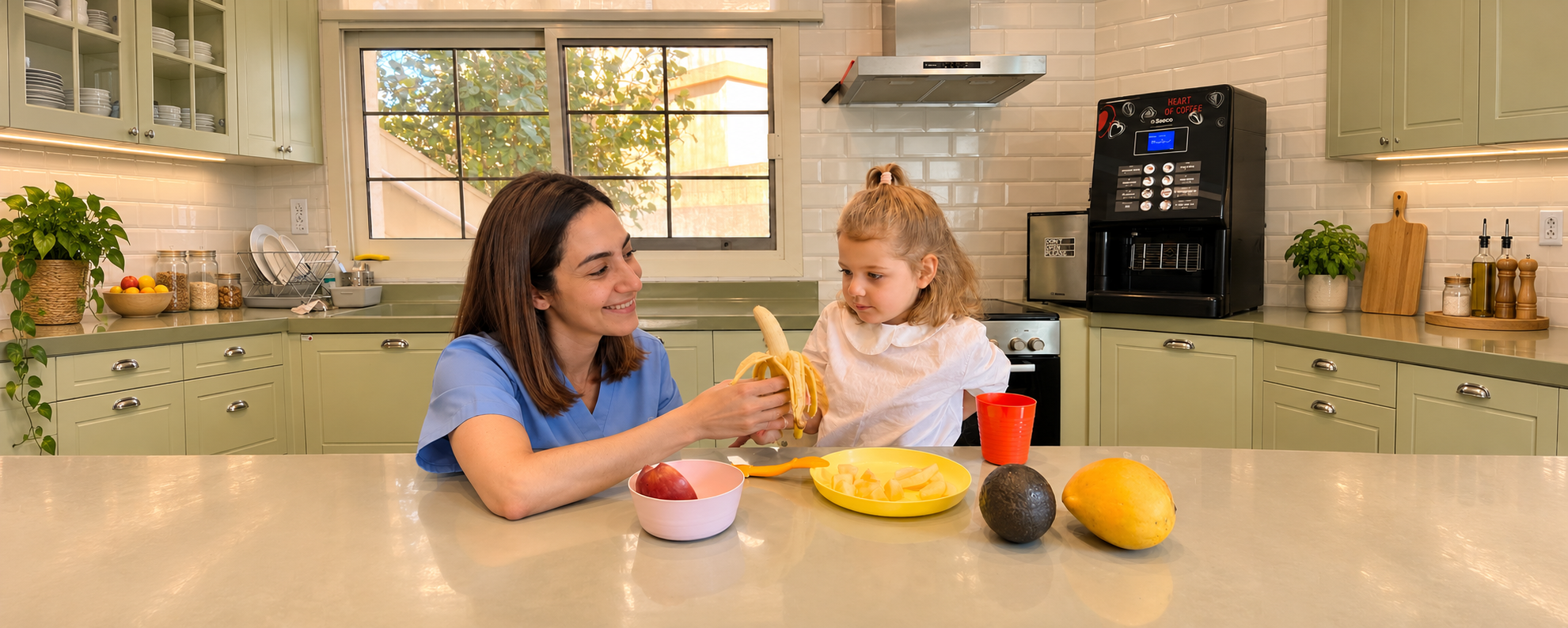

When people think of feeding therapy, they usually picture nutrition, chewing, and swallowing safely. All of that is true and important, but mealtimes are also one of the richest, most naturally repeated communication opportunities a child has every single day. For many of the children we see, the dinner table is where feeding and language work meet.
Why Mealtimes Matter for Communication
Think about how much language happens around food: requesting more, refusing something, commenting on taste or texture, waiting for a turn, and following a simple instruction like “take a bite” or “put it down.” A meal happens two or three times a day, every day, which makes it one of the most consistent, low-pressure settings to build both feeding skills and communication together, rather than treating them as separate goals.
For children with more complex feeding needs, including those we support around swallowing safety and texture modification using IDDSI (International Dysphagia Diet Standardisation Initiative) guidelines1, mealtimes can understandably feel stressful for the whole family. Research suggests that for children and adults with learning disabilities, mealtimes can become more about managing eating and swallowing than about social exchange2. Building in small, achievable communication moments can help shift the focus away from just “getting food in” and toward connection, choice, and participation.
The Sensory Side of Mealtimes
Communication at the table does not happen in isolation from everything else going on for a child in that moment. Texture, temperature, smell, noise, and even the lighting in a room all shape how regulated and ready to engage a child feels. A child who is overwhelmed by a strong smell or an unfamiliar texture is unlikely to have the capacity to request, comment, or try a new word, no matter how motivating the activity looks on paper. Slowing mealtimes down, introducing new foods alongside familiar, accepted ones, and watching for early signs of sensory overload (turning away, gagging, covering ears, going quiet) help create the regulated, calm state that communication depends on. This is one of the reasons feeding, sensory, and language goals are so closely linked, and why they are most effective when planned together rather than addressed in separate sessions with separate strategies.
Simple Ways to Build Communication3 Into Mealtimes
- Offer choices, not just food. Holding up two options and pausing gives your child a reason to communicate through a word, a sign, a point, or a glance, rather than simply receiving what is put in front of them.
- Pause and wait. After placing food down or between bites, wait a few extra seconds before jumping in. This gives your child time to initiate a request, a refusal, or a comment in their own way.
- Narrate, don’t quiz. Comment on what’s happening (“mmm, crunchy,” “all gone,” “your turn”) rather than firing questions. This models language without putting pressure on your child to perform.
- Use the same core words every time. Words like “more,” “done”, “help,” and “want” come up naturally at every meal, making mealtimes an ideal place to model core vocabulary consistently, whether your child is using spoken words, signs, or AAC.
- Respect refusal as communication too. Pushing away, turning the head, or closing the mouth are valid ways of saying “no” or “I’ve had enough.” Acknowledging these responses, rather than working around them, builds trust and reduces mealtime stress over time.
Signs Your Child Is Already Communicating at the Table
Communication at mealtimes does not always look like words, and many parents are already responding to signals without realising it. Some of the earliest, most reliable forms of mealtime communication include:
- Eyes shifting/ looking towards a food item, a person, or an empty plate.
- Vocalising or reaching when a preferred food comes into view.
- Pushing a spoon or cup away to signal “no more” or “not this.”
- Bringing a hand to the mouth or an object to a caregiver as an early request.
- Changes in posture or pace such as slowing down or turning away, which often signal fatigue or sensory overload before a child has the words to say so.
Noticing and naming these moments out loud (“you pushed that away, okay we are all done”) help a child understand that their signals are being heard and understood; which is, ultimately, the whole foundation communication is built on.
When Feeding and Language Goals Overlap
For children receiving feeding therapy alongside speech and language support, we often build communication targets directly into mealtime plans. For example, teaching a request sign for “more” using the same texture and pacing agreed with the feeding team, so the child is not managing two unrelated sets of expectations. This kind of joint planning is exactly why feeding and language therapy benefit from sitting under one roof, with the same team talking to each other.
Questions Parents Often Ask
- My child is non-speaking. Can we still do this? Yes. Every strategy above works without spoken words; a glance, a reach, a sign, or a picture symbol all count as communication, and modelling AAC/ visuals or gesture at mealtimes is just as valuable as modelling verbal language.
- What if mealtimes are already a battle in our house? Start small. Pick one strategy, such as pausing and waiting, and use it for a single meal a day rather than overhauling the whole routine at once. Reducing pressure around food would ideally come before communication goals are added.
- How long before we see a difference? Every child is different, but because mealtimes happen several times a day, small, consistent changes tend to show results faster than once-a-week therapy strategies alone. Repetition is what makes mealtimes such a powerful setting in the first place.
The Takeaway
A meal is never just about the food. It is a daily repeated opportunity for a child to make choices, express preferences, and be understood, skills that matter just as much as safe swallowing and adequate nutrition. Supporting both together, rather than in isolation, gives families one less thing to juggle and gives children a mealtime that works for their whole development, not just their plate.
If mealtimes feel like a daily source of stress in your home, you do not have to manage the feeding and the communication side of it separately. Our team works across both areas, so the plan you get is a single integrated plan, not two.
References
- International Dysphagia Diet Standardisation Initiative. The IDDSI Framework. © The International Dysphagia Diet Standardisation Initiative 2016. Licensed under CC BY-SA 4.0. https://iddsi.org/framework
- Harding C, Wade C, Harrison K. Communication between children and carers during mealtimes: what can we learn to improve communication opportunities for children with learning disabilities? J Res Spec Educ Needs. 2013;13(4):242–250. https://openaccess.city.ac.uk/id/eprint/3346/1/Communication%20between%20children%20and%20their%20carers%20during%20mealtimes.pdf
- Pepper J, Weitzman E. It Takes Two to Talk: A Practical Guide for Parents of Children with Language Delays. Toronto: The Hanen Centre. https://www.hanen.org